How Sitting for 8+ Hours a Day Is Damaging Your Posture

1. The Hidden Cost of Prolonged Sitting
Sitting for extended hours has become an unavoidable reality for millions of office workers, remote professionals, and students. While sitting feels like rest compared to standing, it places continuous mechanical stress on your spinal column and supporting muscle groups.
When you sit down, the pelvis tilts backward, flattening the natural inward curve of the lower back (lumbar lordosis). Without proper lumbar and cervical support, the head naturally drifts forward toward screens, adding up to 30 lbs of extra pressure onto cervical vertebrae.
Biomechanical Fact
For every inch your head moves forward from neutral alignment, your neck muscles must carry an additional 10 pounds of force to keep your eyes facing forward.
2. The Muscle Imbalance Cycle: Shorten & Weaken
Prolonged static posture triggers what physical therapists refer to as the "Shorten-and-Weaken" muscle imbalance cycle:
- Overactive & Tight: Hip flexors, chest muscles (pectoralis major), and upper trapezius become chronically tight and shortened.
- Underactive & Weakened: Gluteal muscles, deep abdominal core, and lower trapezius weaken due to disuse and prolonged stretching.
Over months and years, this pattern shifts your baseline posture into hyper-kyphosis (rounded upper back) and forward neck slump—even when you stand up.
3. 5 Simple Desk Micro-Exercises to Reset Posture
You don't need a full gym routine to undo sitting strain. Performing these 30-second micro-exercises every 60–90 minutes keeps your spinal discs hydrated and muscles activated:
1 Seated Hip Flexor Stretch
Sit at the edge of your chair, extend one leg back with your toe on the floor, and gently push your pelvis forward until you feel a pull across the front hip.
2 Doorway Chest & Pectoral Opener
Place forearms against a doorframe at shoulder height and step forward until your chest opens up, reversing shoulder slumping.
3 Chin Tucks (Cervical Decompression)
Look straight ahead, glide your head backward without tilting your chin down, holding for 5 seconds to align neck vertebrae over shoulders.
4 Scapular Squeezes
Squeeze your shoulder blades together as if pinching a pencil between them for 5 seconds, activating upper back stabilizers.
5 Glute & Core Engagement
Squeeze your glutes tightly for 10 seconds while drawing your navel in toward your spine to wake up dormant support muscles.
4. How Ergonomic Sleep Restores What Sitting Damages
While daytime micro-stretches prevent postural collapse, your body requires 7 to 8 hours of nocturnal spinal decompression to heal micro-tears in muscles and rehydrate intervertebral discs.
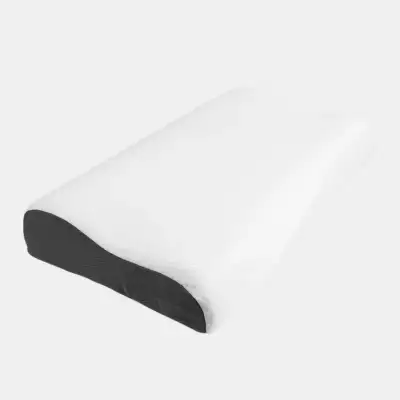
Using an anatomically contoured cervical memory foam pillow like the EOXO Cervical Contour Pillow restores the natural 35°–45° lordotic arc of your neck overnight, eliminating muscle tension built up during 8 hours of computer work.